

Illegal betting means betting that the law prohibits; unregulated betting means betting that no relevant regulator oversees. At Cassinos BR we keep the two apart, because a foreign license, a Brazilian authorization and the right to accept players in Brazil are three different things – a casino can be regulated abroad and still offer a service that’s banned here.
Brazil’s MP nº 1.394/2026 prohibited operating, offering, intermediating and advertising fixed-odds betting, including the online games that fell under that framework. The measures also cover blocking unauthorized websites and restricting their payment channels, while lottery types already authorized by law aren’t affected.
Calling a bet illegal means being clear about the activity, the country and the rule involved. For players, the risk under current law is a fine for betting on unauthorized gambling (art. 50, § 2º, of the Lei das Contravenções Penais) – a minor offense, not a crime – and the criminal penalties in the government’s new bill only apply if Congress passes it.
The same goes for questions like “is bet at home online casino illegal”: the answer depends on where you are, since one brand can be licensed in one country and unauthorized in another. That’s why we look at who runs a casino, what restrictions apply today, how payments work and how complaints are handled – and say clearly where the picture is still uncertain.






What Counts as an Illegal Bet in Brazil
An illegal betting service is one that offers something Brazilian law prohibits. At Cassinos BR we keep that apart from three other things that often get mixed up with it: a missing license, a suspected scam and a player’s own liability. Here’s how common situations compare:
| Situation | What it means | What it doesn’t mean |
| Offering fixed-odds betting covered by MP nº 1.394/2026 | The measure bans operating, offering, intermediating and advertising it nationwide | That every kind of lottery is banned |
| Holding a foreign license | The casino may be authorized in the country that issued it | That it’s exempt from Brazilian restrictions |
| Appearing in old SPA records | The operator was authorized under the previous rules | That it can take deposits today |
| Showing no license you can check | Nobody can confirm who oversees it | That it’s definitely a fraud |
| Holding back a withdrawal | There’s a payment dispute that needs looking into | That it’s automatically a scam – or that the refusal is justified |
| Copying another operator’s identity | It may be impersonation | That the site belongs to the company whose logo it uses |
Illegal, Unregulated and Scam Sites
These three words describe different problems. We call something illegal when it goes against the law that applies, unregulated when no relevant authority oversees it, and a scam when there’s evidence of deception, such as a fake brand or a made-up fee to release a payment.
So is it illegal to bet online? It depends on the activity and on whose actions you’re asking about. The current ban targets operating and advertising these services, but players aren’t entirely outside the law either: art. 50, § 2º, of the Lei das Contravenções Penais provides for a fine for betting on unauthorized gambling, which is a minor offense rather than a crime. The new criminal offenses the government has proposed are a separate bill, and they don’t apply unless Congress passes it.
The bet.br Domain and the SPA Authorized List
The .bet.br domain and the SPA records show which platforms belonged to the former federal authorization framework, and the Ministry now publishes those records as authorizations held before MP nº 1.394/2026 took effect. To check a site, we match the exact domain, company name, CNPJ, brand and authorization order rather than trusting the suffix alone.
And is it illegal to bet on sports online? For fixed-odds sports betting in Brazil, the measure covers it just as it covers the online games in the same framework, so an old listing doesn’t override the ban, and a refund process isn’t a green light to start betting again.
We look at each service through the rules in force today and the evidence about that specific site, keeping authorization, scam allegations and player liability as separate questions.
How Brazil Regulated Betting: Key Dates
In less than eight years, Brazil went from legalizing betting to licensing it at federal level and then banning it in September 2026. At Cassinos BR we use these dates to tell an old authorization apart from the rules in force today:

- 12 December 2018: Law nº 13.756/2018 legalized fixed-odds sports betting, without automatically authorizing any website to operate;
- 29 December 2023: Law nº 14.790/2023 extended the framework to online games within the fixed-odds regime, which wasn’t a blanket legalization of every gambling product;
- 21 May 2024: Ordinance SPA/MF nº 827 set the requirements for operators applying to serve the national market;
- 1 January 2025: the federal licensed market opened, with SPA authorization required, .bet.br domains for authorized sites and up to three brands per authorization;
- 25 September 2026: MP nº 1.394/2026 banned the covered betting activities nationwide, and new deposits stopped the same day;
- 5 October 2026, 23:59: the deadline for players to withdraw their money directly from the affected platforms;
- 6 October 2026: the platforms had to go offline, so a former authorization no longer meant access for play;
- 7 and 8 October 2026: operators had to report remaining balances to the banks, identified by CPF;
- 9 to 14 October 2026: banks return those balances, and money that can’t be returned passes to Caixa Econômica Federal for repayment.
Whenever we assess an illegal bet claim, we check it against the rules that applied on that date – an old license or a .bet.br domain isn’t proof of permission today.
How Illegal Bets Are Blocked
Blocking illegal betting in Brazil means finding unauthorized operators and cutting off their websites, apps, advertising and payments. At Cassinos BR we keep that official process apart from the blocks you can set up on your own devices:
1. Authorities identify unauthorized services.
The Ministry of Finance monitors the market to find platforms offering prohibited betting – a site that still opens isn’t authorized just because it’s online.
2. Domains are sent for blocking.
The SPA passes the domains it identifies to Anatel, which restricts access to those addresses, but new or related domains may not be caught straight away.
3. Apps and payment channels are targeted.
Enforcement also covers removing apps and restricting the payment methods unauthorized operators use, so a casino’s page can still load while a particular way of paying no longer works.
4. Advertising is restricted separately.
The ban covers advertising as well as operating and offering these services – taking down promotions stops casinos recruiting players, while blocking a domain stops people reaching the site.
5. Location blocks are a different matter.
Searches like “betting sites block vpn” are often about a casino’s own access controls rather than government enforcement. An error message mentioning a VPN doesn’t tell you why you’re blocked, and using a VPN to get around it doesn’t make playing legal – many casinos also treat it as a breach of their terms.
6. You can block betting on your own devices.
If you’re looking into how to block betting sites for yourself, use your phone’s or computer’s content restrictions or a gambling filter, delete betting apps, switch off promotional notifications and ask for self-exclusion at any casino where you have an account.
7. Check how much a blocker really covers.
Before trusting a tool that promises to block all betting sites, check whether it works across browsers, apps, devices and networks – no list of domains catches every new address.
Government blocks, a casino’s own restrictions and the controls on your devices are three different things, and a blocked page only makes sense once you know which one you’re looking at.
How to Spot an Illegal or Fake Betting Site
An illegal site and a fake one aren’t always the same thing, so it pays to check three things separately: whether the site is allowed to operate, who’s behind it and whether there are signs of deception. At Cassinos BR we treat warning signs as reasons to look closer, not as automatic proof of an online casino scam:
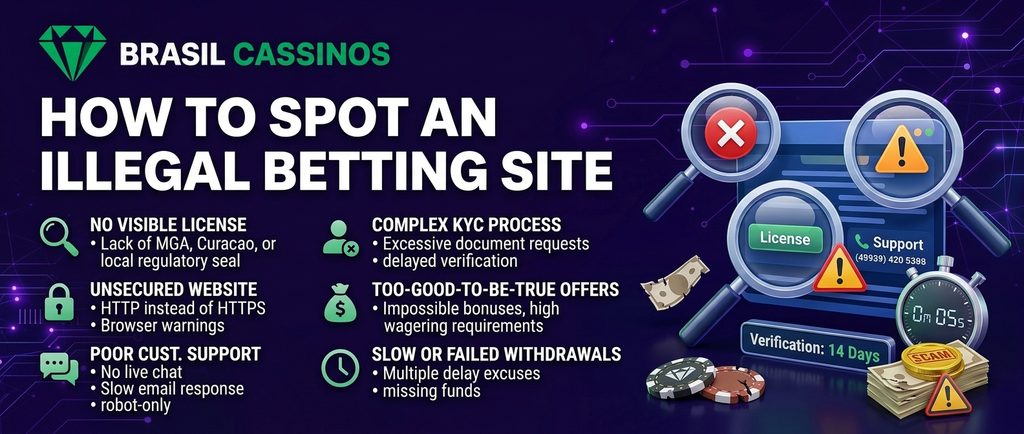
- unclear ownership: no company details, different names in different policies or an address you can’t verify make it hard to know who’s holding your money;
- license claims that don’t check out: a license badge should match a record in the regulator’s register for that exact operator, and an old Brazilian authorization doesn’t mean the site can take deposits today;
- copied branding: a familiar logo on a different domain proves nothing about who owns the site, so go to the brand’s address from a source you already trust;
- oversight you can’t confirm: calling a site an unregulated casino needs evidence about which jurisdiction applies – a certificate that won’t open leaves the license unconfirmed, but doesn’t prove there’s no license anywhere.
Red Flags in Payments
With payments, the questions are where your money is going, what it takes to get it out and whether anyone is asking for sensitive details. Watch for:
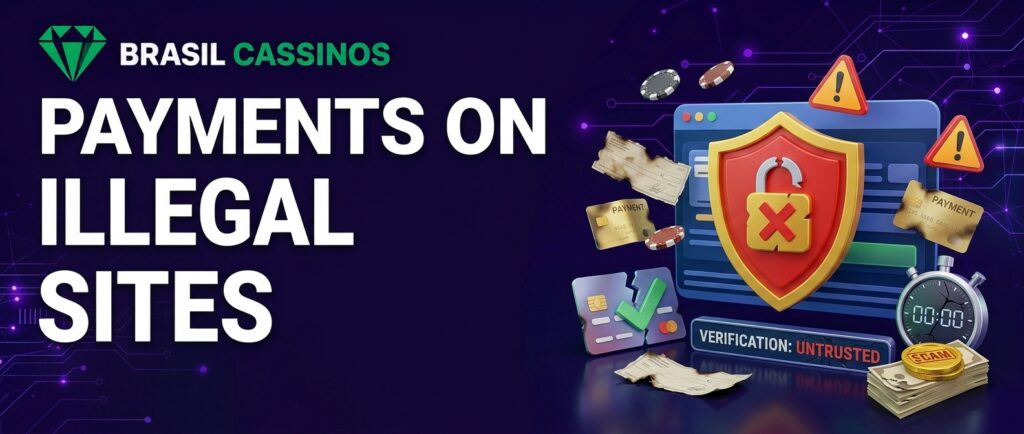
- unexplained recipients: a payment company in between is normal, but a personal account or an unrelated company is not, so get an explanation before you send anything;
- fees to release winnings: a “tax”, “insurance” or “unlock fee” requested in chat is a scam pattern, especially when new charges keep appearing after you pay – don’t pay it;
- requests for your credentials: no genuine support agent needs your bank password, authentication codes, wallet seed phrase or private keys;
- conditions that keep changing: if new requirements keep appearing without reference to the terms, complain in writing and keep all the messages;
- payouts you can’t trace: an “approved” status doesn’t mean money was sent, so ask for the bank reference or the blockchain transaction ID.
Red Flags in Promotion
With promotions, the warning signs are claims you can’t check and conditions that are hidden. We always compare the ad with the full terms of the offer and with what we know about the operator:
- guaranteed profits: promises of sure wins, no-loss betting or predictable results are never real;
- fake endorsements: government logos, celebrity photos or screenshots of big payouts don’t prove a site is authorized or backed by anyone;
- hidden conditions: if the rollover, deadline, maximum bet or withdrawal cap isn’t published, there’s no way to judge the offer;
- pressure to act now: unexpected messages pushing you to pay before you can read the terms are designed to stop you checking;
- paid “recovery” services: someone offering to get your blocked money back for an upfront fee is a common follow-up scam, even if they already know your account details – don’t pay them.

A site operating without permission and a site trying to defraud you are different problems, but an unexplained payment request or an identity that doesn’t add up is always a reason to stop and check.
Common Betting Scams in Brazil
Betting scams are built to get your deposits, your personal data or more and more payments out of you. At Cassinos BR we keep these apart from ordinary gambling losses and from withdrawal disputes that are still open. The patterns that come up most often:
fraudsters copy a well-known brand's look and send people to a different address, often through Telegram or WhatsApp groups, and any deposit or login you enter there never reaches the real operator;
a prize appears on screen and then becomes conditional on another payment, followed by more requirements – keep the original offer and every demand, and don't pay;
systems, "signals" or bots sold as a sure source of income are backed only by cherry-picked screenshots that hide the losses, and no one can guarantee betting returns;
someone contacts you about a failed payout and asks for your banking login, codes, remote access or wallet seed phrase – no real investigation needs these, so reach the casino only through a channel you found yourself;
a page shows winnings you can't trace anywhere and then asks you to pay to unlock them, but a screenshot only proves what the screen shows, not that the money exists;
if you're trying to work out how to recover money from an unlicensed online casino scam, you may be contacted by "recovery agents" promising guaranteed results for an upfront fee or claiming special access to regulators, banks or the blockchain – it's a second scam, so don't pay or share your account details;
an affiliate post dressed up as independent advice can hide conditions or the fact that it's paid, so when you look up a scam casino online, rely on evidence about the operator and your transactions, not on a promotional post.
Not every loss or delay is a scam: we judge suspected fraud by who received the money, the transaction records, who owns the domain and what was said in writing.
What Happens to Your Money on an Illegal Bet
Money sent to an unauthorized betting site can end up in different places: still in your account, already wagered, stuck in a dispute or with a fraudster. At Cassinos BR we treat each of these separately, because each needs different evidence and a different way of getting money back:

- deposits: a payment receipt proves the transfer happened, not that the casino credited it, kept it available or will let you withdraw it, so compare the receipt with your account history;
- wagered money: separate settled losses from open bets and your remaining balance – a losing bet isn’t fraud, and the casino being unauthorized doesn’t automatically undo your original payment;
- winnings on screen: a balance shows what the platform reports, not that a payout has been sent, so ask for an account statement and the status of any withdrawal;
- blocked access: a blocked domain can lock you out without telling you anything about your funds, so keep your screenshots, receipts and messages and contact support only through a channel you already trust;
- refused withdrawals: ask in writing for the reason, the clause it’s based on, any verification still needed and a complaint reference – and if you’re asked for extra deposits again and again, treat it as a scam, not a delay;
- Pix fraud: if there’s evidence of a scam, contact your bank quickly, since the Banco Central’s MED lets victims request a review within 80 days of the transfer – though it doesn’t cover ordinary disputes and doesn’t guarantee a refund;
- former .bet.br balances: these follow the official closure refund process, with banks paying back between 9 and 14 October 2026, and that process doesn’t cover money held by offshore casinos;
- recovery offers: if you’re looking for a way to recover money from an unlicensed online casino scam, be wary of paid “recovery services” – keep your transaction records and don’t pay a fee or hand over documents to anyone promising to get your money back.
What you can recover depends on the payment trail, who runs the casino and which complaint routes exist – and some of what’s been lost or disputed may never come back.
How to Report an Illegal Betting Site
Reporting an illegal betting site means getting your evidence to the right authority. At Cassinos BR we keep three things apart, because they go through different channels: reporting the site, reporting a fraud and trying to get your money back:
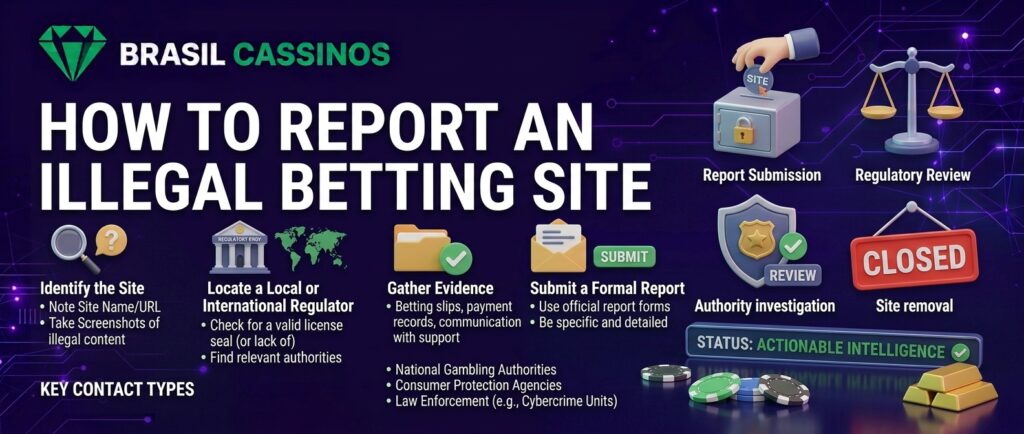
- save the evidence: note the exact domain, the page addresses, dates, the company name the site shows and what you think is wrong, keep screenshots, receipts, withdrawal references and messages, and describe facts as facts and suspicions as suspicions;
- report the site on Fala.BR: sign in with your gov.br account, choose “Nova manifestação” and then “Denúncia”, select “Ministério da Fazenda (MF)” for betting matters and add the site addresses and your evidence;
- decide whether to identify yourself: an identified report lets you follow it up on the platform, while an anonymous one is possible but comes without a protocol number or tracking;
- report fraud to the police: an online casino scam involving impersonation, stolen logins or deceptive transfers may call for a Boletim de Ocorrência at a Polícia Civil station or through your state’s official online police service, with your evidence attached;
- contact your bank separately: a Fala.BR report doesn’t dispute a payment, so tell your bank about suspected fraud through its official channels straight away – a fraudulent Pix may qualify for a MED review within 80 days, though repayment isn’t guaranteed;
- use consumer channels for contract disputes: check whether the company is on Consumidor.gov.br before filing there, and if it isn’t or nothing comes of it, ask Procon or another consumer-protection service for help;
- keep every reference: save submission confirmations, police report details, bank protocols and replies, send sensitive documents only through official channels and never include passwords, codes or wallet recovery phrases.
Reporting a banned activity, investigating fraud and recovering money are separate processes, so each issue needs to go to its own channel.
Illegal Bets vs Foreign-Licensed Casinos
Illegal betting is about what the law where you are prohibits; a foreign license is about permission granted somewhere else. At Cassinos BR we look at both, because a casino can hold a perfectly valid license abroad and still offer a service that’s banned in Brazil:
- What’s legal here depends on the activity and the place: Brazil’s current ban covers operating, offering, intermediating and advertising fixed-odds betting, and a foreign license doesn’t exempt anyone from it;
- A foreign license has to be checked: we look at the issuing regulator, the operating company, the license status and what it covers, because a badge or certificate image alone doesn’t show the site belongs to the licensed company;
- No Brazilian permission isn’t the same as no oversight at all: calling something an unregulated casino means saying which regulator is missing, so we separate a confirmed foreign license, an unconfirmed claim and clear evidence that a casino lacks the authorization it needs;
- A regulator won’t always get your money back: a foreign license may give you somewhere to complain, but that body’s rules decide which disputes it takes, and none of them guarantees a refund;
- Fraud is a separate finding: a casino can be both unauthorized and deceptive, but impersonation, fake certificates and dishonest payment demands need their own evidence – a slow withdrawal on its own isn’t proof of fraud;
- Claims about a brand need precise backing: a question like “is bet at home online casino illegal” isn’t evidence against anyone, and any answer has to name the exact domain, company, country, activity and date;
- Players are a separate question: the ban targets operators, but Brazilian law also provides for a fine for players who bet on unauthorized gambling (art. 50, § 2º, LCP), while the new criminal offenses proposed by the government only apply if Congress passes them.
We always show a casino’s foreign license and Brazil’s restrictions side by side – an overseas license is never presented as permission to serve players here.
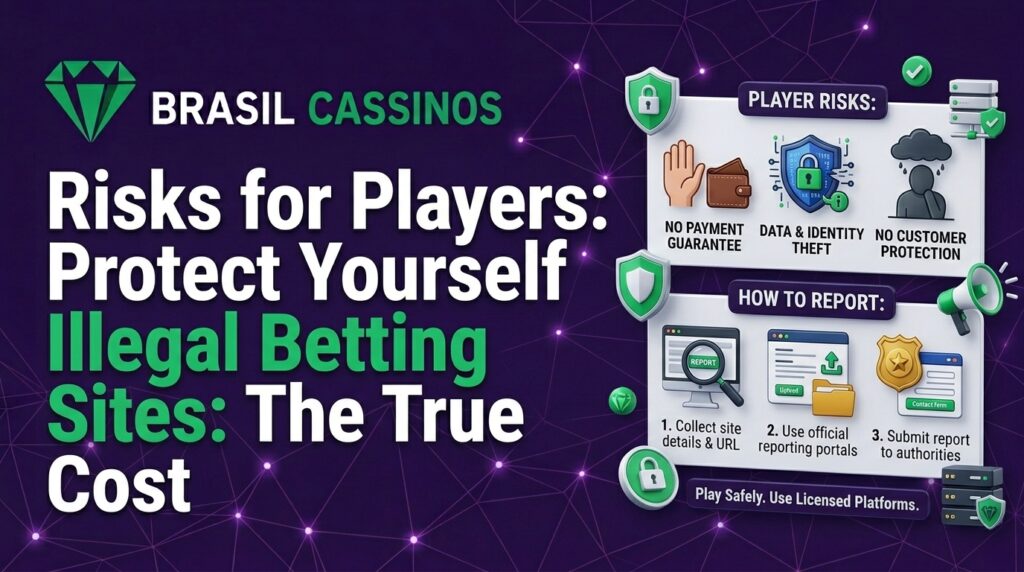
Risks for Players
Playing on an illegal or unverified betting site can cost you money, lock your account, expose your personal data and leave you with few ways to get anything back. At Cassinos BR we look at these risks for players separately from the casino’s own legal status:
- a VPN doesn’t change the law: if you’re asking “is using a vpn to sports bet illegal”, the VPN isn’t really the issue – betting on unauthorized gambling is what Brazilian law addresses, with a possible fine for players (art. 50, § 2º, LCP), and a different IP address doesn’t change where you live;
- the law and the casino’s rules are separate: so “is it illegal to use a vpn to sports bet” has two answers – breaking a casino’s terms with a VPN can get your account closed and your balance held, which is a different thing from breaking the law;
- verification can freeze your money: a casino can ask for ID and proof of location after you sign up and keep deposits and withdrawals blocked until the checks are done, so details that don’t match can turn into a dispute even if registration went through;
- access and payments can fail separately: domain blocks, app removals and restricted payment channels mean a page that still opens is no guarantee that withdrawals still work;
- your data can be misused: documents, CPF details and payment records sent to an impersonator can cost you far more than your betting balance, so check who you’re sending them to and never share banking passwords, codes or wallet recovery phrases;
- recovery may be partial or impossible: a Pix fraud review has eligibility rules and no guarantee of a refund, and an ordinary gambling loss or a contract dispute isn’t fraud;
- more payments mean more losses: a demand for extra deposits to release a balance is a scam pattern, and borrowing to cover losses or paying a “recovery agent” only adds to what you stand to lose.
Being eligible, giving accurate account details, having proof of your payments and keeping control of your data are four separate checks – passing one doesn’t settle the others.
Conclusion
An illegal site, an unverified casino and an outright scam are three different problems, and each one calls for a different response. At Cassinos BR we keep them apart: a foreign license doesn’t make a casino legal in Brazil, and a site that won’t load or a slow withdrawal isn’t automatically fraud. Whatever happens, keep your payment records, take each issue to the right channel – the authorities, the police, your bank or a consumer service – and be wary of anyone asking for more money to fix it. Good records won’t guarantee you get your money back, but without them a complaint rarely goes anywhere.
Frequently Asked Questions
Brazilian law, not the operator's location. MP nº 1.394/2026 banned operating, offering, intermediating and advertising fixed-odds betting within its scope, including the online games in that framework. Players are a separate question: the ban targets operators, though the law also provides for a fine for betting on unauthorized gambling.
No. Illegal means the activity breaks the law that applies, unregulated means no relevant authority oversees it and fraud means someone is deceiving you. A site can be more than one of these, but a missing license alone doesn't prove it's a scam.
No. A foreign license only covers what it was issued for in that country, and it doesn't override Brazilian restrictions. We look at a casino's foreign license and its permission to serve players in Brazil as two separate questions.
No. The suffix marked sites in the former federal licensing framework, and the Ministry now lists those records as authorizations held before MP nº 1.394/2026. An old entry doesn't give a site permission to take deposits today.
Using a VPN isn't what the law targets – betting on unauthorized gambling is, and that carries a possible fine for players rather than a criminal charge. A VPN doesn't change where you live or make a banned service legal, and most casinos treat it as a breach of their terms, which can get your account closed and your balance held.
Copied branding, payments going to unexplained recipients, certificates you can't verify, promises of guaranteed profits and repeated demands for money to release winnings. Anyone asking for your banking password, authentication codes or wallet recovery phrase is a scammer – never share them.
Possibly. You can ask your bank for a MED review within 80 days of the transfer, but ordinary disputes aren't covered and a refund isn't guaranteed. Report it quickly and keep your receipts and messages.
On Fala.BR: choose "Denúncia" and send betting matters to the Ministry of Finance, with the exact domain and your evidence. If you've been defrauded, also file a police report and tell your bank.
No. Reporting a site helps enforcement but doesn't recover money – payment disputes, fraud investigations and consumer complaints are separate processes, each with its own reference. Avoid anyone who promises guaranteed recovery for an upfront payment.
Banks are returning balances reported by CPF between 9 and 14 October 2026, and anything they can't return passes to Caixa Econômica Federal for repayment. This only applies to the former .bet.br platforms, not to offshore casinos.