


A no KYC casino is one that advertises play without the usual identity checks. KYC stands for “Know Your Customer” – the process a casino uses to confirm who you are. At Cassinos BR we keep two things apart: signing up without documents and withdrawing without them. Plenty of casinos let you do the first and still keep the right to ask for ID later.
A no KYC crypto casino adds crypto payments to the mix. Paying from a wallet doesn’t make you anonymous, doesn’t lift country restrictions and doesn’t guarantee you’ll be paid without documents – a casino’s terms can still allow ID and location checks and hold withdrawals until they’re done.
If you’re looking for the best crypto casino no KYC, the things that matter are what triggers a verification request, the withdrawal limits, the supported networks, the fees and whether Brazil is accepted at all. We don’t call a casino verification-free if its terms allow checks later on, and a foreign license doesn’t exempt it from Brazil’s current betting restrictions.






Best No KYC Casinos in 2026
No casino can promise you’ll never be asked for ID – even the ones known for light verification keep that right in their terms. At Cassinos BR we compare what each casino actually says about when it checks documents. Before signing up from Brazil, make sure the casino’s terms accept players here:
| Casino | License shown | When ID can be requested | Published no-ID limit | Payments | Withdrawal time (as stated by the casino) |
| Rainbet | Anjouan, stated by the operator | Not for ordinary crypto transactions, but suspicious activity can trigger extra checks; Interac needs Level 2 verification | None published – the $15 minimum withdrawal isn’t a KYC threshold | Crypto, plus Interac and AstroPay in eligible regions | 5-15 minutes to process, plus 5-45 minutes for the network to confirm, depending on the coin |
| Duelbits | Curaçao Gaming Authority, stated by the operator | A verified e-mail is enough for standard amounts; documents may be needed for larger withdrawals, regulatory reasons or manual reviews | None published – “no maximum cap” isn’t the same as never needing ID | BTC, ETH, SOL, USDT, USDC and other coins; all withdrawals are paid in crypto, even after fiat deposits | 10-30 minutes for BTC, longer for some coins or flagged withdrawals |
Not every casino with a crypto-first reputation works this way. Shuffle (Natural Nine B.V., Curaçao license OGL/2024/1337/0628), for example, asks for ID before the first withdrawal and at a threshold it sets itself, can request proof of where your money comes from and can hold payouts until verification is done – so it doesn’t belong on a no-KYC list.
Whatever a casino advertises, signing up without documents doesn’t mean you’ll be paid without them. The terms are what count, not the “no verification” banner.
What a No Verification Casino Means
An online casino without verification usually advertises an account process without immediate identity-document uploads. For cassino-onlinebr.com, we examine which checks are deferred, which remain mandatory, and whether the withdrawal policy supports the advertising.
- Email verification confirms access to an email address; it does not establish identity or residence.
- Identity verification checks personal details against identification or other evidence.
- Payment verification checks ownership of the account or instrument used to transfer funds.
- Source-of-funds checks examine where deposited money originated and may require separate financial records.
No KYC at Sign-Up vs No KYC at Withdrawal
An online casino without verification usually means you can open an account without uploading ID straight away. At Cassinos BR we look at which checks are just postponed, which ones can’t be skipped and whether the withdrawal rules match the advertising. It helps to know the four types of checks a casino can run:
- e-mail verification: it confirms you can access an e-mail address, not who you are or where you live;
- identity verification: it checks your personal details against an ID document or other evidence;
- payment verification: it confirms that the account or card used to send money is yours;
- source-of-funds checks: they look at where your money came from and can require separate financial records.
No KYC at Sign-Up vs No KYC at Withdrawal
No KYC at sign-up just means you don’t need documents to create an account. Calling a site a no verification withdrawal casino goes much further – it suggests you can cash out without any document checks, which only the terms can confirm.
Even a crypto casino without KYC can still collect your account details and review your transactions. Rainbet’s help centre, for example, says ordinary crypto play and withdrawals don’t need KYC, but it keeps the right to ask for more if it spots suspicious activity – so its policy isn’t an unconditional exemption.
Withdrawal limits need careful reading too: a minimum payout, a daily cap or a promise of unlimited withdrawals isn’t the same as a document-free allowance, and we only quote a KYC threshold when the casino actually publishes one.
When Verification Can Still Be Requested
Before relying on any label, anyone looking for the best no KYC crypto casino should read when the terms allow checks later on. The usual triggers are:
- the first withdrawal: Shuffle’s current terms, for example, require an ID check before the first payout, even if you signed up earlier;
- a threshold: a casino can start checks once your activity reaches a level it When Verification Can Still Be Requested
- sets, and if that level isn’t published, nobody can tell you what it is;
- suspicious activity: Rainbet keeps extra verification for accounts it considers suspicious, without a published trigger amount;
- payment ownership or source of funds: Shuffle’s terms allow checks on who owns the payment method and requests for bank statements, payslips, tax records or other proof of funds, with withdrawals restricted in the meantime.
Signing up without documents is one thing; getting paid without them is another – and the terms decide which one a casino really offers.
How We Chose No KYC Casinos
We compared what the casinos publish about verification and withdrawals, without treating “no KYC” advertising as a promise. At Cassinos BR we read the operators’ documentation only – we didn’t open accounts or test payouts. Here’s how we went about it:
Signing up without documents, routine withdrawals without documents and a complete exemption from ID checks are three different policies, and we don't rate them the same way.
We compare promotional pages and help articles with the terms that actually apply. Shuffle's current terms require ID before the first withdrawal, so it doesn't make a strict no-KYC list.
We note what the terms say about suspicious activity, transaction thresholds, location, payment ownership and source of funds – Rainbet, for example, skips routine KYC for ordinary crypto transactions but keeps extra checks for suspicious activity.
A minimum withdrawal or a maximum per transaction says nothing about how much you can take out without ID, and if a casino doesn't publish a document-free limit, we don't invent one.
Verification can change with the payment route – Rainbet's Interac option needs Level 2 verification and a confirmed e-mail, unlike its usual crypto process, so the whole platform can't be called "no verification".
We present payout times as the casino's own estimates and keep processing time apart from blockchain confirmation – none of them come from withdrawals we made ourselves.
A casino's license statement stays a claim until it's confirmed in the regulator's register, and lighter ID checks don't give a casino permission to serve players in Brazil.
Finding the best online casino without verification takes clear exceptions, workable withdrawal terms and confirmed eligibility – which is why this page compares policies instead of ranking casinos with scores.
We include casinos because their policies are clearly documented, and we show their conditions alongside the advertised benefits.
No KYC Casinos vs bet.br Casinos
“No KYC” describes how a casino handles document checks; “.bet.br” marked domains in Brazil’s former federal authorization framework. At Cassinos BR we compare them separately, because one is about paperwork and the other is about legal status:
- registration: a crypto casino no KYC offer may let you open an account without uploading ID, but that says nothing about withdrawals – and a former .bet.br authorization was a legal status, not a promise of a quick sign-up;
- later ID checks: foreign casinos can keep the right to verify you even after a light sign-up, as Rainbet does for suspicious activity and Shuffle does before the first withdrawal;
- checks by payment method: requirements can change with the way you pay – at Rainbet, ordinary crypto transactions skip routine KYC, while Interac needs Level 2 verification;
- proof of authorization: a foreign license has to be checked against the operator and regulator, and a former Brazilian authorization against the SPA records (company, CNPJ, brand, domain and authorization order) – neither a marketing label nor a domain suffix replaces that;
- access from Brazil today: the Ministry now lists its records as authorizations held before MP nº 1.394/2026, so former .bet.br sites only matter for their history and refunds, and lighter ID checks don’t exempt a foreign casino from the ban;
- existing balances: the refund process for the closed Brazilian platforms is based on balances reported by CPF and the related bank accounts, and it doesn’t cover money held by foreign casinos;
- privacy: uploading fewer documents means sharing less at sign-up, not being anonymous – the casino still has your account data and payment records, and may ask for documents later.
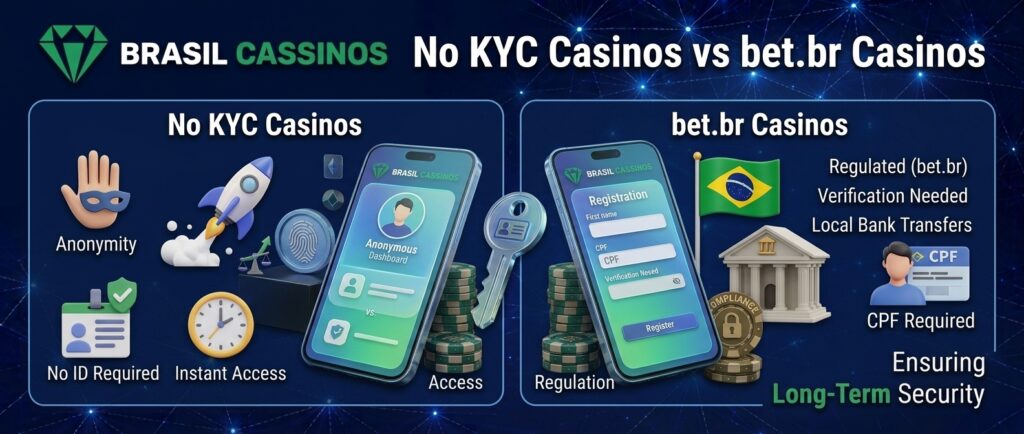
How many documents a casino asks for and whether it’s allowed to serve Brazil are two separate questions – lighter KYC doesn’t make a casino authorized or guarantee you’ll get your money out.
Pros and Cons of Playing without KYC
A casino without KYC can mean fewer documents during everyday use, but how much that helps depends on its withdrawal rules and the exceptions in its terms. At Cassinos BR we weigh that convenience against the chance of checks later on and money you can’t reach.
Pros
Where a casino’s policy really does cut back on verification, a few things get simpler:
- fewer steps at sign-up: you don’t have to photograph your ID, find proof of address or take a selfie at that stage;
- less sensitive paperwork shared up front: no ID copies at registration means less material in the casino’s hands, though it still collects account and transaction data;
- no routine document review: where ordinary withdrawals skip document checks, that waiting stage disappears – Rainbet’s help policy describes this for crypto, with exceptions for suspicious activity;
- simpler wallet payouts: crypto withdrawals go straight to your own wallet without a bank transfer, as long as you get the coin, network, address and fees right.
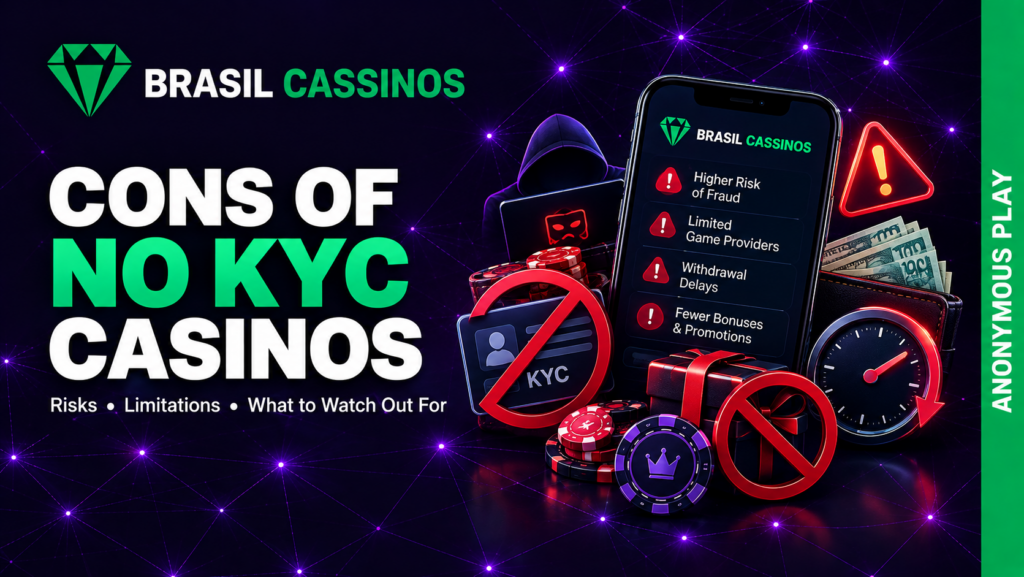
Cons
A casino no verification claim can hide checks that are only postponed, not removed:
- checks after you’ve deposited: a casino can take your money and only ask for ID when you withdraw, holding the payout until it has reviewed your documents;
- unclear document-free limits: if the threshold isn’t published, you can’t know when verification will kick in, and one smooth payout doesn’t guarantee the next;
- limited privacy: skipping ID uploads doesn’t mean the casino knows nothing about you – Shuffle’s terms, for example, mention device, location, payment and blockchain screening;
- costly crypto mistakes: a wrong wallet address or an unsupported network can mean losing the money for good, and network fees and price changes affect what you receive;
- harder account disputes: if something goes wrong, you may still need to prove who you are or that the payment method is yours, and refusing all checks clashes with terms that reserve them;
- no Brazilian permission: lighter KYC and Brazil’s ban are separate matters, and a simpler sign-up doesn’t exempt a casino from the current prohibition.
The real benefit is fewer routine document checks – and it’s limited by the casino’s right to verify you later, its payment rules and whether it can serve Brazil at all.
Payment Methods without Verification
Whether you can pay without uploading documents depends on two things: the casino’s own policy and the provider that moves the money. At Cassinos BR we keep casino checks apart from the checks a bank, exchange or payment service runs on its side.

Crypto: Bitcoin, USDT and Other Coins
Crypto payments move coins between wallet addresses. A bitcoin casino no KYC claim is about the casino’s ID policy – accepting Bitcoin doesn’t by itself mean withdrawals skip verification. What to check:
- Bitcoin: the minimum withdrawal, the network fee and how many confirmations are needed – Duelbits, for example, lists a $50 minimum and 10-30 minutes for BTC withdrawals, figures it publishes itself rather than results we tested;
- USDT: the exact network, such as TRC-20 or ERC-20, because the coin name isn’t enough – the sending network, the receiving address and the casino’s support all have to match;
- other coins: ETH, SOL, USDC and others each have their own minimums, fees and settlement times, so a limit published for one coin doesn’t apply to another;
- the exchange’s rules: a crypto casino no verification offer doesn’t change what the exchange you use to buy or sell the coins requires, so check those rules separately;
- the casino’s approval: the blockchain only starts confirming once the casino sends the transaction, and a withdrawal waiting for an ID review hasn’t got that far – Rainbet, for instance, can still ask for checks on suspicious activity;
- your records: keep the coin, network, amount, destination address and transaction hash, and never share your seed phrase or private key to prove a payment is yours.
Pix at No Verification Casinos
Pix moves money between accounts in seconds, but it doesn’t really fit the idea of a casino without verification: every Pix transfer comes from a bank account registered to a CPF, so it’s never anonymous. Before relying on it:
- there’s always a record: the transfer leaves a trace in your bank account, whatever the casino’s document policy says;
- deposits aren’t withdrawals: check whether Pix works both ways and whether the receiving account has to match your CPF – a Pix logo on the deposit page doesn’t answer that;
- approval comes first: Pix itself is fast, but a withdrawal can sit in review for much longer, so compare the casino’s review time with the transfer time;
- payments can be cut off: Brazil restricts the payment channels used by unauthorized operators, so a Pix option today is no guarantee it will keep working – or that the casino is allowed to operate.
We only call a payment route document-free within the exceptions the casino publishes – never as a promise of anonymity, eligibility in Brazil or guaranteed payouts.

Withdrawal Limits without Documents
A withdrawal limit without documents is the amount a casino lets you take out before ID checks kick in – when it actually publishes one. At Cassinos BR we keep that apart from minimum payouts, transaction caps and the casino’s right to check you anyway:
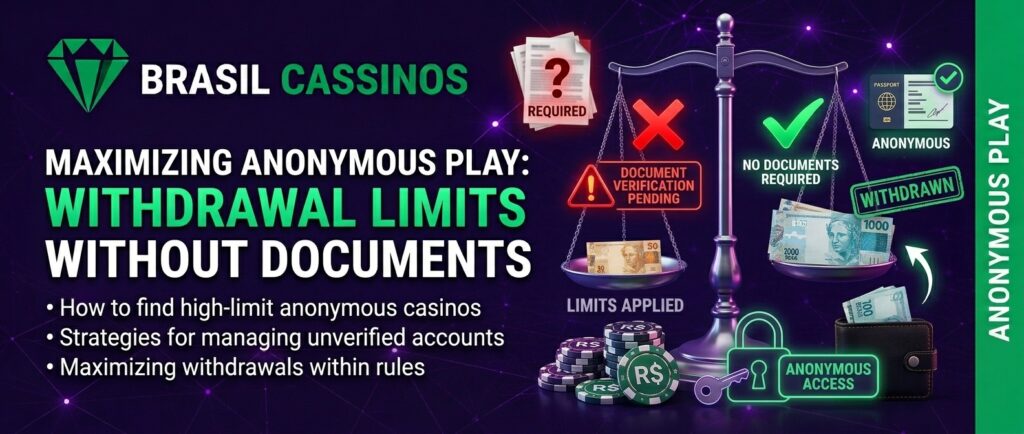
- minimum withdrawal: the smallest payout a payment method accepts – Rainbet’s terms set it at $15 or the equivalent, except when closing an account, and that’s a minimum, not a document-free ceiling;
- maximum payout: transaction, daily or monthly caps control how much you can request in a period, and Duelbits saying it has no maximum withdrawal cap doesn’t mean it will never ask for ID;
- verification threshold: a real threshold states the amount, currency, period and which activity counts – a cumulative limit isn’t the same as a per-withdrawal one, and we don’t invent a figure when the casino doesn’t publish one;
- checks at the casino’s discretion: even a payout below the stated limit can trigger a document request under separate review rules, which is why Rainbet’s crypto exemption depends on there being no suspicious activity;
- first-withdrawal checks: calling a site a no verification withdrawal casino doesn’t fit terms that require ID before the first payout, as Shuffle’s do;
- what you can actually withdraw: open bets, bonus conditions and rules on wagering your deposit can shrink the available balance, but those are balance rules, not KYC limits;
- fees and conversion: check whether a limit applies to the amount you request or the amount you receive after charges, and remember that exchange rates change the value of crypto balances;
- “instant” promises: an instant withdrawal casino no verification offer mixes two separate claims – not needing documents doesn’t mean instant approval, and fast blockchain settlement won’t speed up an account review;
- payouts held for review: ask support which rule applies, what evidence is needed and how to follow the case – splitting a withdrawal into smaller ones won’t get around cumulative or discretionary checks and can itself draw attention.
We only quote a document-free limit when the terms define one; if they don’t, we leave it open instead of guessing.
How to Sign Up at a No Verification Casino
Signing up at a no KYC casino usually means creating an account without uploading ID straight away. It only takes a few minutes, but the order matters, because most problems come up later, at the first withdrawal:
1. Check that you can sign up.
Offshore casinos aren’t authorized in Brazil, and a working sign-up form or a foreign license doesn’t change that. Also make sure the casino’s own terms don’t exclude players from Brazil.
2. Check the site and the company.
Make sure the domain matches the operator’s details from a source you trust, and read the company name, privacy policy and terms before entering any personal data.
3. Read the withdrawal verification rules.
Look for ID checks before the first payout, checks at the casino’s discretion and requirements tied to particular payment methods – signing up without documents doesn’t mean withdrawing without them.
4. Choose a sign-up method.
Use the e-mail, phone or other option the casino offers, give accurate information and use contact details you control.
5. Secure your account.
Pick a unique password, switch on two-factor authentication if it’s available and keep recovery codes somewhere private, away from your usual messages.
6. Confirm your contact details.
Follow the e-mail or phone confirmation step – it proves you control that contact, not who you are or where you live.
7. Review your account settings.
Check your details, the account currency, marketing preferences and spending controls, and fix any mistakes through the official process instead of opening a second account.
8. Check payment conditions before depositing.
Look at the supported coins and networks, withdrawal minimums, fees, bonus conditions and any verification exceptions – a successful sign-up isn’t proof that you’ll be able to withdraw.
9. Keep a copy of the terms.
Save dated copies of the verification and withdrawal rules and any written answers from support, and if a genuine check comes up later, send documents only through the casino’s official channel.

Opening an account is only the first step – whether you’re allowed to play and what it takes to withdraw are separate questions.
Conclusion
A “no verification” label tells you very little on its own. At Cassinos BR we look at what it means in practice – from sign-up requirements to withdrawal checks, fees and published document-free limits – so you can tell a casino that genuinely cuts routine paperwork from one that only advertises anonymity. Before you trust any no KYC offer, read the written withdrawal terms, look for the exceptions that let the casino ask for ID later and check that it accepts players from Brazil at all.
Frequently Asked Questions
KYC stands for "Know Your Customer." A no-KYC claim usually means you don't have to upload ID at a particular stage – and the key question is whether that applies only to sign-up or to ordinary withdrawals too, and which exceptions let the casino verify you later.
No. A casino can let you open an account and still require ID before paying out – Shuffle's terms, for example, call for an identity check before the first withdrawal. Sign-up rules and withdrawal rules always need to be checked separately.
There's no safe answer without checking eligibility first. Among the casinos we compared, Rainbet and Duelbits publish the lightest ID policies for crypto, while Shuffle asks for documents before the first payout. Before signing up, check that the casino's terms accept players from Brazil – lighter KYC doesn't make a casino authorized here.
Yes, if its terms reserve that right. Rainbet, for example, skips routine KYC for ordinary crypto transactions but can ask for more if it sees suspicious activity, so its exemption is conditional, not permanent.
There's no universal limit, and none of the casinos we compared publishes a specific document-free amount. Minimum payouts and maximum transaction caps are different rules – neither tells you how much you can take out without ID.
No. Casinos can still collect your account, device, location and transaction data, and the exchange you use to buy or sell crypto may run its own ID checks.
No. Every Pix transfer comes from a bank account registered to a CPF, so it's never anonymous. Whether the casino also checks your ID depends on its own policy – and on whether the receiving account has to match your CPF.
Not necessarily. Skipping documents and fast payouts are separate things: the casino approves a withdrawal before it's sent, and a review can hold it up. Rainbet, for example, quotes 5-15 minutes for processing plus network confirmation time – its own estimate, not our test result.
Ask in writing which requirement applies, which documents are needed, how to send them and how to track the review. Check that you're dealing with the real casino before uploading anything, never share bank passwords, codes, private keys or seed phrases, and keep the withdrawal reference and your messages.
No. Many casinos look at your total activity or can ask for documents regardless of the amount, and splitting payouts to dodge checks can itself trigger a review. What matters is whether the written terms allow your withdrawal without documents.